Why Lower Back Pain Keeps Coming Back (And What to Do About It)
You've been here before. The lower back flares up, you rest, you stretch, maybe book a few appointments — and eventually it settles. Life goes back to normal. Then a few months later, there it is again. Same spot. Same dull ache working its way into something you can't ignore.
If you're asking "why does my back pain keep coming back?", you're not alone — and the answer is more straightforward than most people realise. It usually comes down to two things: the patterns that are still running in the background, and the habit of stopping when the pain stops.
Why Short-Term Approaches Give Only Temporary Relief
Most people approach lower back pain the way we approach a flat tyre — deal with the immediate problem, get moving again, and carry on. That's understandable. Pain is uncomfortable, and getting out of pain is a reasonable goal.
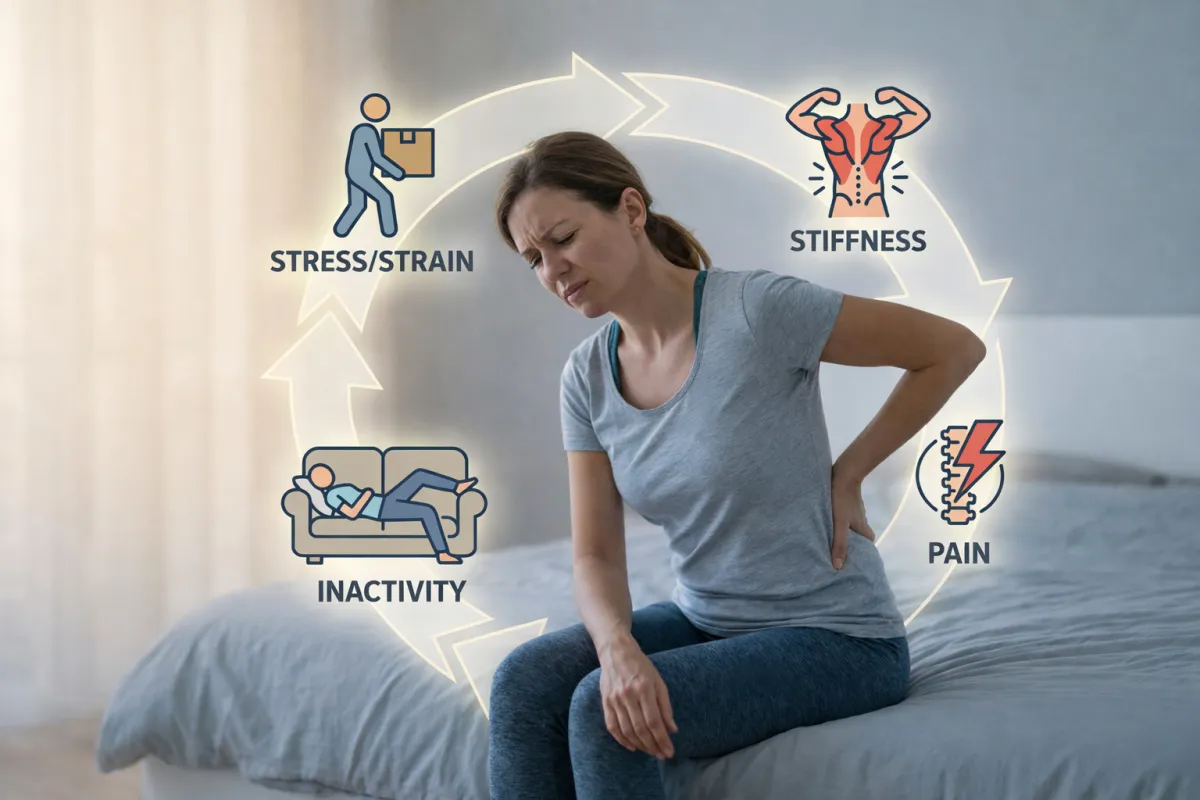
But pain fading is not the same as the underlying issue being resolved. It often means the body has adapted enough — through muscle tension, altered movement, compensation — to quiet the signal for a while. The structure hasn't necessarily changed. The inputs driving the problem haven't necessarily changed. So the same conditions that produced the pain the first time around are often still present.
Short-term approaches that focus purely on symptom reduction can provide real relief. The limitation is that relief alone doesn't address what caused the problem in the first place.
The Two Real Reasons It Keeps Coming Back
1. Your Daily Patterns Haven't Changed
Think honestly about how your body spends the majority of its time. Sitting for long stretches at a desk or in a car. Sleeping on your stomach. Not walking nearly as much as your body is designed to. Scrolling with your head dropped forward.
Your spine adapts to the positions and loads it encounters most consistently. When those patterns are repeated day after day, the structure responds over time — and not always in a way that supports long-term wellbeing.
This is one of the most common reasons lower back pain in Hastings and elsewhere keeps returning. The flare-up comes and goes, but the underlying pattern stays constant. You can do all the right things during the bad spell — and still find yourself back in the same position six months later because the daily inputs haven't shifted.
Lasting change tends to require looking honestly at the habits your spine is being shaped by, not just what you do during the crisis.
2. You Stop When the Pain Stops
This one is worth sitting with, because it's almost universal.
When back pain arrives, people tend to do all the right things. They start walking again. They prioritise sleep. They book appointments and follow through. They take their body seriously. And those things work — the pain eases, they feel better, and life gets busy again. Gradually, the habits that helped fall away.
Here's the insight that changes everything: the things that help you recover are the same things that keep you well.
Consistent movement. Understanding what's happening in your spine. Staying engaged with your structural health rather than waiting for pain to force your hand.
The problem isn't that people don't know what helps. It's that pain becomes the only reason to act. By the time it arrives, the body has often been under quiet stress for a while. A reactive approach means you're always a few steps behind — addressing the flare rather than the conditions that produced it.
How Compensation Makes It Worse Over Time
There's a layer worth understanding here. When one area of the spine or pelvis is under persistent stress, adjacent areas begin to compensate. Muscles tighten. Movement patterns shift. The body redistributes load in whatever way keeps it functioning.
Over time, these compensation layers build up. The area that hurts may not be the primary source of the problem — it may simply be the part of the system that's running out of room to adapt.
This is why lower back pain isn't always a lower back problem in isolation. The position of the pelvis, how weight is distributed across the feet, the position of the spine above — these all influence what the lower back is dealing with on any given day. Addressing only the symptomatic area without looking at the whole structural picture often means the problem keeps recurring.
What a Structural Assessment Looks For
At Structural Chiropractic in Hastings, the focus is on understanding the structural position of the spine — not just responding to where it hurts.
Rather than relying on a single method, five distinct forms of assessment are used to build a complete picture:
Digital Structural Analysis — precise digital measurement of spinal positioning
Functional Movement Assessment — observing how the body moves under load
Weight Distribution Scales — identifying asymmetrical load distribution across the body
Advanced Spinal Palpation — hands-on assessment of individual spinal segments
Thermography — scanning heat patterns to assess nervous system function
Using five methods rather than one means any structural shifts present can be identified with greater confidence. This is a different starting point to simply assessing pain — the goal is to understand why the spine is under stress, and whether a structured approach to addressing that is appropriate for you.
Ready to Get a Clear Picture?
If lower back pain keeps returning despite your efforts, it may be worth asking whether you've ever had a thorough look at what's actually happening structurally.
A complimentary consultation at Structural Chiropractic in Hastings gives you the opportunity to discuss your full history, understand what structural correction involves, and determine whether a full assessment is the right next step — with no obligation to proceed.
Book your complimentary consultation →
Or call us on 06 651 1004
Structural Chiropractic | 807 Heretaunga Street East, Hastings | Focusing on Structural Correction