
Chiropractic and Nervous System Research: What the Evidence Is Actually Showing
Chiropractic and Nervous System Research: What the Evidence Is Actually Showing
The conversation around chiropractic care has shifted significantly over the last two decades. Where it was once discussed almost entirely in terms of pain relief and joint mobility, a growing body of chiropractic nervous system research is exploring a different question: what happens in the brain when the spine is adjusted?
This post is a plain-language look at some of that research — what it shows, what it doesn't show, and why the nervous system is central to how we think about structural care at this clinic.
Why the Nervous System Matters for Structural Care
Structural Chiropractic isn't focused on symptom relief as its primary goal. The focus is on spinal structure — and the reason that matters is the spine's relationship to the nervous system.
The spinal column houses and protects the spinal cord, which carries signals between the brain and the rest of the body. Structural shifts in spinal position — the kind we assess using our five-method process — can influence how those signals travel and how the nervous system interprets and integrates sensory input from the body.
Think of it the way a mechanic looks at a vehicle's chassis. The chassis doesn't just hold the car together — it determines how every system connected to it performs. Underlying structural shifts in the framework create secondary effects that compound over time. The same principle applies to the spine.
What the Haavik Research Shows
Dr. Heidi Haavik is a New Zealand-based neuroscientist who has spent over two decades researching the neurological effects of chiropractic adjustments. Her work is among the most cited in this area.
In a 2016 study published in the journal Neural Plasticity, Haavik and colleagues investigated what happens in the prefrontal cortex — the brain's region responsible for planning, decision-making, and sensorimotor integration — following a spinal adjustment. The study used electroencephalography (EEG) to measure cortical activity before and after adjustments in subjects with subclinical neck pain.
The findings showed measurable changes in prefrontal cortex activity following the adjustment. The researchers proposed that this reflects a change in how the brain processes sensorimotor input — the signals it receives from the body about its position, movement, and load.
What does that mean in plain language? The research suggests that adjusting the spine may influence how the brain integrates information from the body — not just locally at the adjusted area, but in higher-level processing centres.
The Autonomic Nervous System Connection
A separate but related body of research looks at the relationship between spinal adjustments and the autonomic nervous system — the system that governs the balance between sympathetic activation (stress response) and parasympathetic recovery.
A 2021 narrative review by Kovanur-Sampath and colleagues explored plausible mechanisms by which high-velocity, low-amplitude spinal adjustments might influence neuroimmune function via the autonomic nervous system. The review describes these mechanisms as "still emerging" — meaning the research is directionally interesting but not yet conclusive.
What makes this line of inquiry relevant is the broader literature connecting autonomic balance to immune function, sleep quality, inflammatory regulation, and recovery capacity. If spinal adjustments have any measurable effect on autonomic tone — and the emerging evidence suggests this is worth investigating — then the downstream implications are meaningful.
The Five-Method Assessment Approach
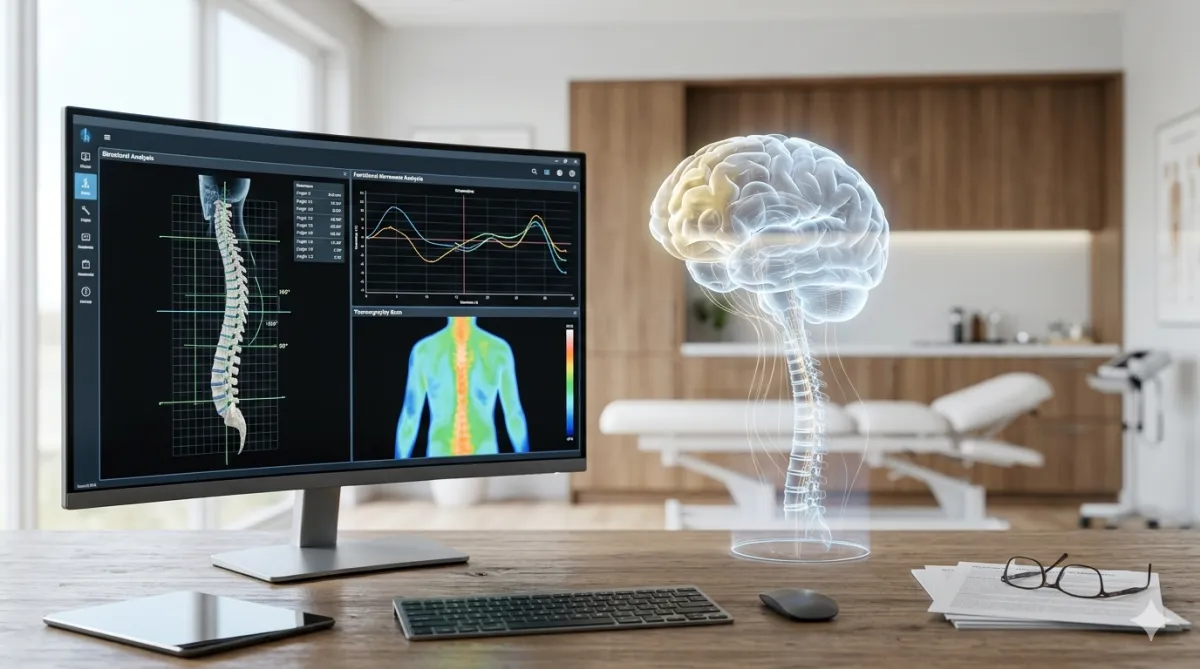
At Structural Chiropractic, we don't rely on a single data point to assess what's happening structurally. Our process uses five specific methods:
1. Digital Structural Analysis — objective measurement of spinal alignment
2. Functional Movement Assessment — how the body moves and compensates
3. Weight Distribution Scales — how load is distributed through the frame
4. Advanced Spinal Palpation — hands-on assessment of tissue quality and joint behaviour
5. Thermography — detecting asymmetries in skin temperature that may reflect nerve-related changes
Using five methods matters because each one captures a different dimension of what's happening. A single X-ray or a single manual assessment gives you one angle. Five methods together build a more complete structural and neurological picture.
Honest About What We Don't Know
Good science is honest about its limits, and so are we.
The research on chiropractic nervous system function is genuinely interesting and growing. But it is still developing. Many studies are small. Mechanisms are proposed, not proven. The field is asking good questions — and the answers are coming in incrementally.
What we can say with confidence is this: the spine and the nervous system are structurally and functionally linked. Structural shifts in spinal position are measurable and assessable. And the growing body of neurological research gives us better language and better tools to understand what structural care is doing — and why it might matter beyond pain relief.
Ready to Look at Your Own Structure?
If you've attended our June workshop or have been following this series, you now have a solid foundation for understanding why we approach care the way we do.
If you're curious about what your own structural picture looks like, a Complimentary Consultation at Structural Chiropractic is the natural next step. We go through your history, walk you through our assessment process, and decide together whether structural correction makes sense for where you are.