

Why Does Posture Get Worse With Age — And What's Really Behind It
Most people don't notice their posture changing day to day.
They notice it in photos.
Or when getting up from a chair feels harder than it used to.
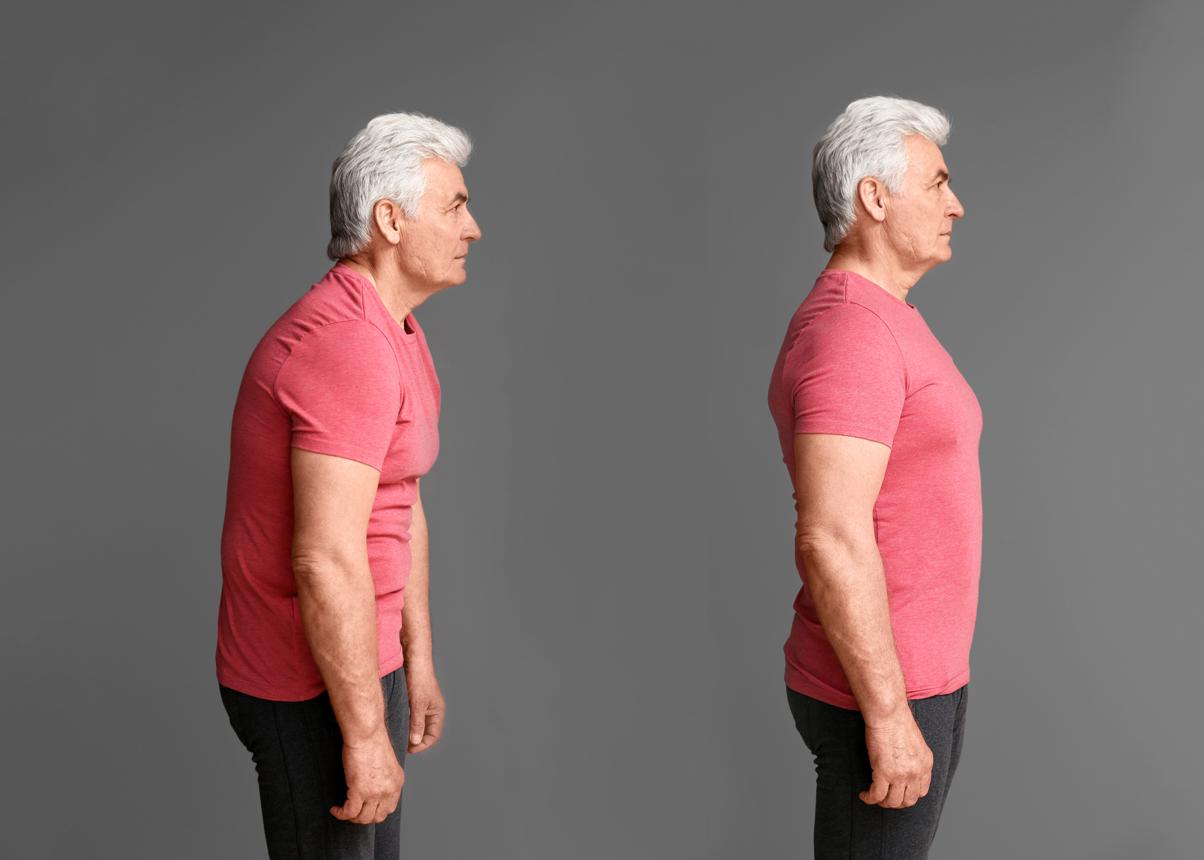
Rounded shoulders. A forward head. A feeling of stiffness or heaviness by the end of the day.
Most people assume this is simply part of getting older. Or weak muscles. Or years of sitting at a desk finally catching up.
But the truth is more hopeful — and more useful — than that.
Posture changes with age are rarely about laziness or lack of effort. They are usually the result of how the nervous system adapts to gravity over time. Understanding that distinction changes everything about how posture can be improved.
Posture Is Not What Most People Think It Is
Posture is often treated as a cosmetic issue — something you fix by sitting straighter or pulling your shoulders back.
Most people find this exhausting. And short-lived. That's because posture is not something you consciously control all day. It is an automatic process, managed entirely by the nervous system.
Your brain is constantly making decisions about:
How upright feels safe
How much muscle tension is needed to stay balanced
How your body should organise itself under the force of gravity
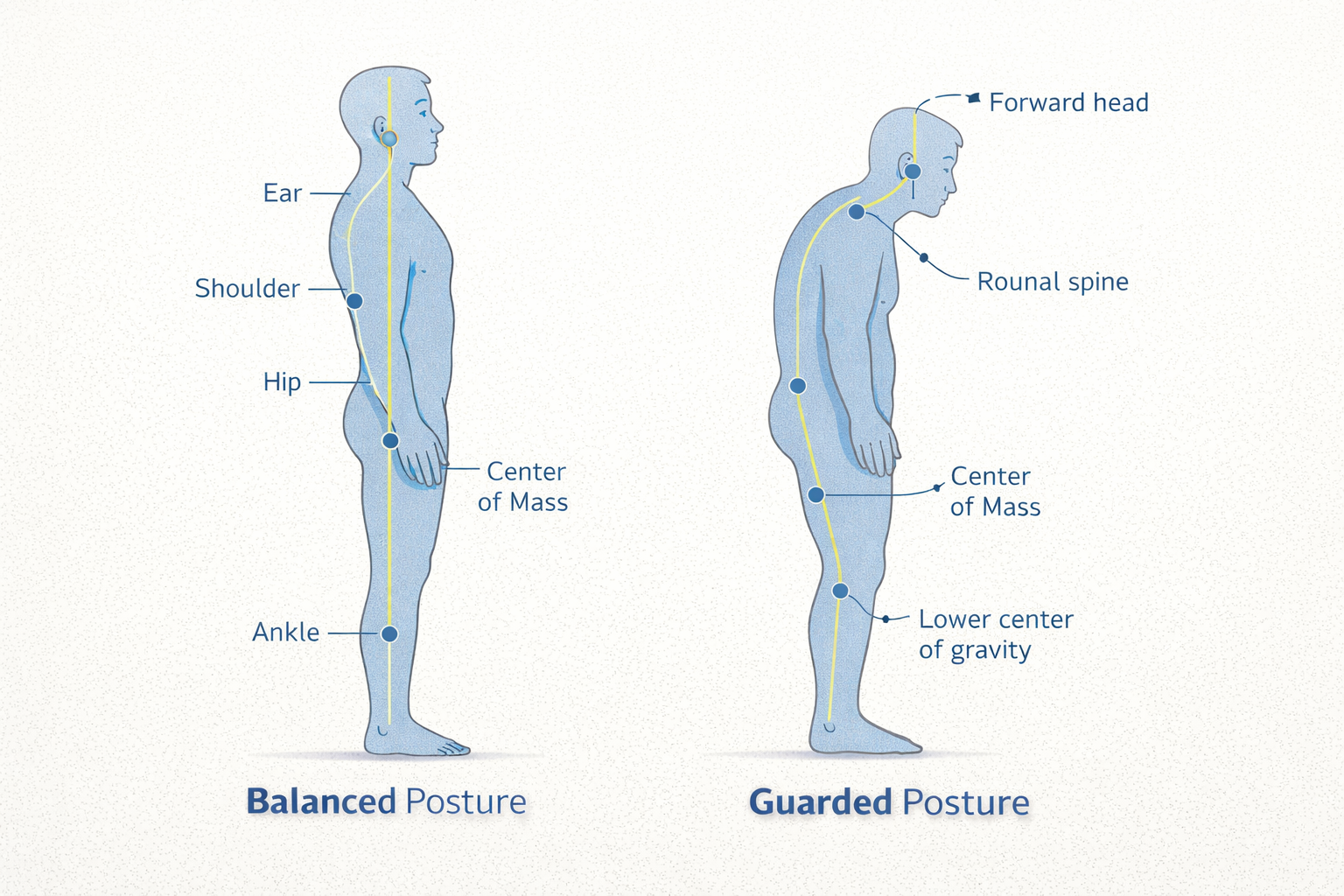
When this system has clear, reliable information to work with, posture looks relaxed and upright. When the system feels uncertain or threatened, posture becomes guarded and rounded — a protective response, not a character flaw.
This is why telling someone to "just stand up straight" rarely works long-term. You cannot consciously override an automatic system all day. What you can do is improve how that system operates.
Why Posture Often Changes as We Get Older
As we age, several things quietly change in the background:
Balance confidence decreases.Small changes in inner ear function, vision, and joint sensation mean the nervous system receives less precise information about where the body is in space.
Reaction speed slows.The speed at which the body can respond to an unexpected shift in balance gradually reduces with age.
Movement variety often narrows.People tend to move less as they age, and when the body moves less, it loses some of the feedback it needs to stay well-organised under gravity.
Sensory input from the spine and joints changes.The spine is full of specialised receptors that send position and movement signals to the brain. When spinal joints lose their normal range of motion, those signals change — and the nervous system adapts accordingly.
None of these changes mean something is catastrophically wrong. They mean the nervous system is working with less clear information. And when that happens, the brain plays it safe.
Why the Brain Chooses a Rounded, Guarded Posture
When balance confidence is lower and sensory input is less reliable, the nervous system often defaults to postures that feel more stable — even if they don't look ideal.
A rounded, slightly forward posture:
Lowers the body's centre of mass (which increases stability)
Increases overall stiffness (which reduces unpredictable movement)
Limits the range of sudden postural shifts
From a pure survival perspective, this makes complete sense. The problem is when this protective pattern becomes the default — even when there is no active threat.
This is why posture tends to deteriorate gradually and progressively. It's not weakness. It's an accumulation of small adaptations the nervous system has made to feel safer.
Why Forcing Better Posture Often Backfires
If posture is a protective output of the nervous system, then trying to force it into a different position often creates more problems than it solves.
Sustained effort to hold yourself upright can:
Increase muscle tension and fatigue
Create new areas of discomfort in the neck and upper back
Feel impossible to maintain, especially later in the day
Reinforce the idea that "good posture" requires constant effort
Lasting postural improvement doesn't come from forcing alignment. It comes from improving the quality of information the nervous system is receiving — so the body no longer needs to default to guarded positions.
The Difference Between Posture Correction and Structural Correction
At Structural Chiropractic, we use the term Structural Correction rather than posture correction — and the distinction matters.
Postureis how you look.
Structureis how your body is organised and functioning under gravity.
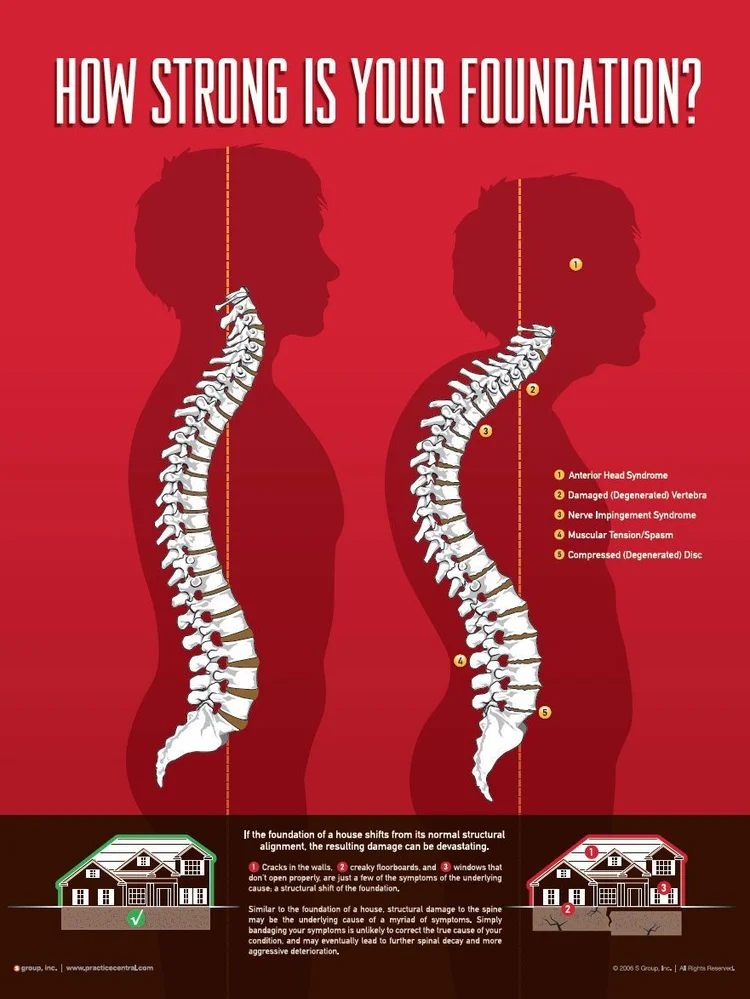
When structure improves — when the joints of the spine are moving well, when sensory feedback is clearer, when the nervous system has reliable information — posture improves naturally. Not because you forced it. Because the system no longer needs the protective pattern it was relying on.
Structural Correction focuses on identifying and improving areas of the spine where movement and alignment have shifted. The goal isn't to make you stand differently — it's to give your nervous system what it needs to organise your body more efficiently on its own.
The Neurology Behind Structural Shifts
Your spine contains a dense network of sensory receptors. They constantly send information to the brain about:
Position and movement
Load and compression
Balance and spatial orientation
When areas of the spine lose their normal range of motion or alignment, the quality of these signals changes. The nervous system interprets this altered input as a reason to increase protective tension — limiting movement, stiffening the surrounding muscles, and defaulting to postures that feel more guarded.
This is not damage. It is protection.
Structural Correction aims to improve movement and spinal function in these areas, so the nervous system receives better signals — and no longer needs to rely on protective postures to compensate.
📍 Concerned about posture changes as you age?
At Structural Chiropractic in Hastings, we help people understand why their posture is changing — not just how it looks. A focused assessment can give you clarity.
Book a Complimentary Consultation →
No pressure. No obligation. Just answers.
What Long-Term Postural Change Can Affect Over Time
Posture alone doesn't cause every health problem. But sustained inefficient posture changes how the body loads and functions — and over time, that adds up.
Neck Tension and Headaches
Forward head posture shifts the effective weight of the head further in front of the spine. For every inch the head moves forward, the load through the neck and upper shoulders increases significantly. This sustained tension is a common contributor to tension-type headaches and chronic neck stiffness.
Low Back Pain and Fatigue
Imbalanced posture changes how load is distributed through the lumbar spine and pelvis. Over time, this uneven loading creates fatigue, stiffness, and discomfort — especially after periods of sitting or standing.
Reduced Balance Confidence
A stiff, guarded posture limits the body's ability to make quick postural adjustments. This reduced adaptability can affect balance, particularly on uneven ground or during direction changes — increasing fall risk over time.
Breathing Efficiency
A slumped ribcage compresses the chest and restricts full expansion of the lungs. Over time, this can reduce breathing efficiency and contribute to feelings of fatigue or breathlessness with light activity.
Digestive Discomfort
Compressed posture reduces the space available for abdominal organs. Some people notice this alongside bloating, reflux, or general digestive discomfort — particularly after meals.
These changes develop gradually, which is why they are so easy to dismiss — until pain or limitation becomes impossible to ignore.
Why Generic Posture Advice Often Misses the Point
Two people can look similarly rounded and have completely different reasons for it.
One may be protecting an old injury the body has never fully released its guard around. Another may have changes in balance confidence driving the pattern. Another may have significant spinal joint restrictions that have built up over years without causing obvious pain.
Generic posture advice — stretch more, strengthen your core, sit up straighter — cannot account for these differences. What works for one person may be irrelevant or even counterproductive for another.
This is why assessment matters more than advice.
A structured chiropractic assessment can identify:
Where structural shifts exist in the spine
How the nervous system is currently adapting
Which areas are restricting movement and altering sensory feedback
What approach makes sense for your body specifically
What to Expect From Structural Correction at Structural Chiropractic
Our approach to postural and structural care starts with understanding — not assumptions.
We conduct a thorough assessment that looks at how your spine is moving, where restrictions exist, and how your nervous system is currently organising your posture. From there, we build a plan specific to what your body needs.
Structural Correction is not about cracking backs and hoping for the best. It is a progressive process of improving movement, improving sensory feedback, and allowing the nervous system to reorganise your posture from the inside out.
Many patients notice changes not just in how they stand — but in how they feel. Less stiffness in the morning. Less fatigue by the end of the day. Greater ease and confidence in movement.
📍 Not sure if posture is the real issue — or just a symptom of something deeper?
A focused assessment at Structural Chiropractic in Hastings can help you find out.
Book a Complimentary Consultation →
No quick fixes. No pressure. Just a clear picture of what's going on — and what can be done about it.
The Bottom Line
Posture isn't something you force. It's something that changes when your nervous system feels stable and supported enough to let your body stand taller again.
If you've been noticing changes in your posture — whether it's rounded shoulders, a forward head, or just a growing sense of stiffness and heaviness — it is worth understanding what's actually driving those changes.
At Structural Chiropractic in Hastings, we're here to help with exactly that.
Frequently Asked Questions
Can posture really be improved in older adults?
Yes. While some age-related changes are expected, postural patterns driven by nervous system adaptation, spinal restrictions, and reduced movement can often be significantly improved at any age with the right approach.
Is poor posture always caused by weak muscles?
Not usually. While muscle weakness can play a role, posture is primarily regulated by the nervous system. Restrictions in spinal movement and reduced sensory feedback are often more significant contributors — particularly in older adults.
How long does it take to see improvements with Structural Correction?
This varies depending on how long patterns have been established and the individual's overall health. Many patients begin noticing changes within the first few weeks of care, with more significant improvements developing over months of consistent treatment.
Is chiropractic care safe for older adults?
Yes. Chiropractic care for older adults is well-established and can be adapted to suit individual needs. At Structural Chiropractic, we adjust our approach based on each patient's age, health history, and comfort.
What's the difference between a chiropractor and a physiotherapist for posture?
Both can help with posture, but chiropractors focus specifically on the spine's structure, movement, and its relationship to the nervous system. Structural Correction chiropractic care is particularly focused on how spinal function affects the body's automatic postural organisation — rather than just exercise-based rehabilitation.
About the author
Dr. Ryno Tope is a Doctor of Chiropractic, a member of the New Zealand Chiropractic Association, and owner of Structural Chiropractic in Hastings and Havelock North, Hawke’s Bay. Dr. Tope focuses on an area of chiropractic called Structural Correction and has been in practice for over a decade. You can reach Dr. Tope at [email protected] or 06•651•1004. You can also follow the Structural Chiropractic Facebook page (www.facebook.com/StructuralChiropracticHB).