
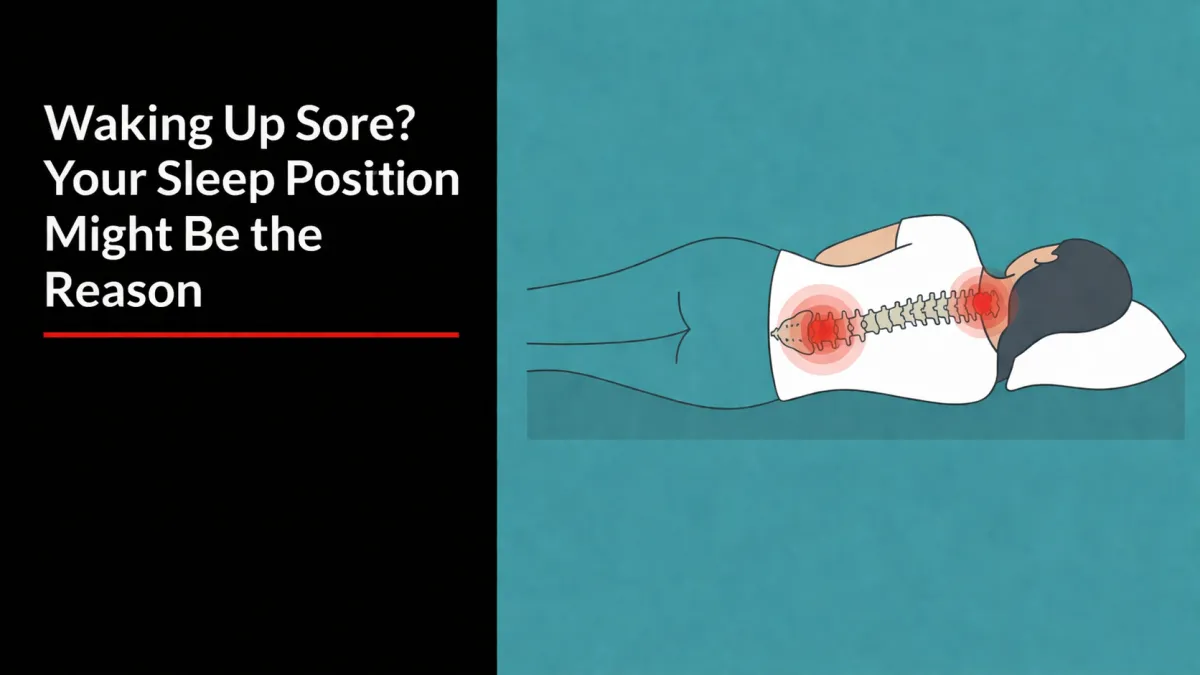
Waking Up Sore? Your Sleep Position Might Be the Reason
You went to bed feeling fine. You wake up stiff, achy, and wondering what happened. Sound familiar?
For a lot of people, mornings are the worst part of the day — not because of bad sleep, but because of how they slept. Your position for the night, held for six to eight hours without adjustment, places sustained load on joints, muscles, and spinal structures in ways that daytime movement tends to disguise. When you’re up and about, your body compensates. Lying still, it can’t.
The good news: a few simple changes to how you set up for sleep can make a noticeable difference in how you feel when you get up.
The Knee Pillow Trick (and Why It Works)
If you sleep on your side, tucking a pillow between your knees is one of the most effective — and underrated — things you can do.
Here’s why it matters. When your top leg drops forward during the night, it creates a rotational pull through your pelvis and lower back. Over hours, that twisting load accumulates. Muscles that were doing fine during the day are now working overtime to stabilise a position you’re not even aware of.
A pillow between your knees keeps your hips stacked, reduces that rotational stress, and takes the strain off your pelvis and lower lumbar. It’s a small change that many people find genuinely improves overnight comfort — particularly those with hip discomfort or lower back stiffness on waking.
One thing worth being clear about: the pillow doesn’t correct anything underneath the surface. It simply reduces the demand your body is placing on an already-stressed area while you rest. Think of it as turning the volume down, not turning off the source.
What About Other Sleep Positions?
Back Sleeping
Back sleeping is generally the most neutral position for the spine, provided your pillow isn’t pushing your head too far forward. The goal is to keep your head, neck, and spine in a relatively straight line. Some people find a small pillow under their knees helpful here too, as it reduces the curve load on the lower back.
Stomach Sleeping
Stomach sleeping is the one to work away from if you can. It forces your neck into sustained rotation for hours at a time and creates an exaggerated arch through the lower back. If you’re a committed stomach sleeper, starting on your side and allowing yourself to drift is a more realistic first step than trying to cold-turkey a position you’ve had for decades.
Pillow Height and Neck Support
Your pillow does more than cushion your head — it’s responsible for keeping your cervical spine (neck) in alignment with the rest of your spine through the night.
For Side Sleepers
You need enough loft to fill the gap between your ear and the mattress. If your pillow is too flat, your head drops and your neck bends sideways for hours. Too thick, and it pushes your head up, creating the opposite problem. A medium-to-firm pillow that holds its shape is generally better than something that collapses under the weight of your head.
For Back Sleepers
You need less height. The goal is gentle support for the natural curve in your neck — not propping your head up like you’re watching TV. Contoured cervical pillows can work well here for the right person.
A quick test: if you wake up with neck stiffness or a dull ache across the shoulders, your pillow height is worth revisiting before anything else.
When the Problem Keeps Coming Back
Here’s something worth considering. If you’ve tried the pillow adjustments, you’ve worked on your sleep position, and you still keep waking up sore — the sleep position may be less the cause and more the revealer.
During the day, your body is active and constantly compensating. Muscle activity, movement, and posture shifts all help manage underlying imbalances. When you’re stationary through the night, that compensation stops — and whatever the underlying issue is, it has nowhere to hide.
That’s not a reason to panic. But it is a reason to look deeper than sleep hygiene.
At Structural Chiropractic, we use five specific methods to assess whether there are structural shifts in your spine affecting how your body is coping — not just at night, but overall. If something keeps showing up in the morning, it may be worth having a proper look at what’s driving it.
Take the First Step
We offer a complimentary consultation — a no-pressure conversation about your health history, what you’ve already tried, and whether structural correction is the right fit for you.
If you keep waking up sore and haven’t been able to get on top of it, this is a good place to start.
📞 Phone: 06 651 1004
🌐 Website: structuralchiro.co.nz
📍 Address: 807 Heretaunga Street East, Hastings, New Zealand